Objections aren’t rejections, they are requests for more information and reassurance
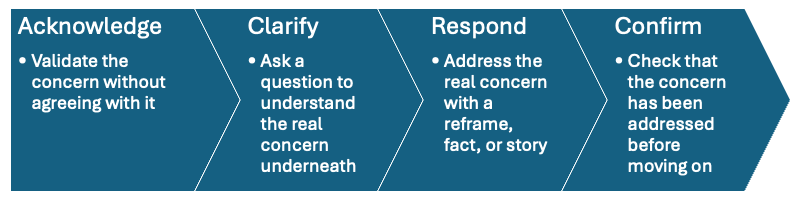
- The ACRC Loop
Top Objections
- Price
- Almost never about actual price.Usually means I haven’t connected the cost to enough value yet
- Price objections are ROI objections in disguise
- Status quo
- People overvalue what they have and undervalue what they could have
- Make the cost of staying put feel real
- Budget
- Two possible reasons:
- Budget Cycle Timing
- Plan around it
- Not a priority yet
- Find the pain
- Budget Cycle Timing
- Two possible reasons:
- Stall
- The vaguest objections are the most dangerous ones
- You should clarify, never guess
- Competition
- Understand why they are considering other competitors, and show the strengths of your tool
- Risk
- Don’t dismiss the concern, understand their concern and address it
- Story Telling and Demos
- A demo is a story where the customer is the hero and Snowflake is the thing that makes them one
- The story ARC
| The world before – stablish the hero’s struggle Start every demo by reflecting back what you heard in discoveryUse their exact phrasesThe customer is the hero of the storyThe hero has a problemRight now, the world is the before |
| The cost of staying – make inaction feel dangerous Before you show the solution, briefly make the cost of doing nothing explicitThe customer should feel the urgencyThis is just a reminder |
| The bridge – introduce the concept, not the product Say one sentence of what’s different about the approachConceptual bridge between the problem and the demoThe reason why this works differently is … |
| The demo – show, don’t tell, in their world The demo should be tight:Two or three scenarios maximum that are tied to their pain directlyNever show a feature because is impressive, show it because it is relevant. |
| The world after – let them see themselves in it After the demo, pain the future stateUse the language they use in the need-payoff questions from discovery |
| The next step = make it specific and easy to say yes to Be clear about the next stepEarly stage: a follow-up calls with the technical teamMid stage: a proof of concept on their real dataLate stage: A commercial discussion with the economic buyer |
An interviewer asks: “Walk me through how you structure a demo.” Give your answer in under 90 seconds.
I think of a demo as a six-part story, not a product tour. I start by reflecting back what I heard in discovery — using their exact words — so everyone in the room knows this was built for them, not a generic audience.
Then I briefly make the cost of inaction real — one sentence that reminds them why this matters now. Before I touch the product, I frame the conceptual shift — what’s architecturally different about how this problem gets solved.
Then the demo itself: two or three scenarios maximum, each one tied directly to a pain they named. Before each scenario I say ‘you mentioned X — here’s what that looks like.’ After each one I pause and check that it landed.
After the last scenario I paint the future state in their words — not features, but what their team’s day looks like when this is live. And I end with a single, specific next step — usually a proof of concept on their real data.
The customer is the hero of the story throughout. Snowflake is just what makes the hero’s life better.
 Daniela Fernandez