Instead of building rapport and responding to what the customer asks for, Challengers lead with insight the customer doesn’t already have – and use that insight to reshape how the customer thinks about their problem.
The best solutions engineers are those who constructively challenged customer thinking
Show the customer what’s possible
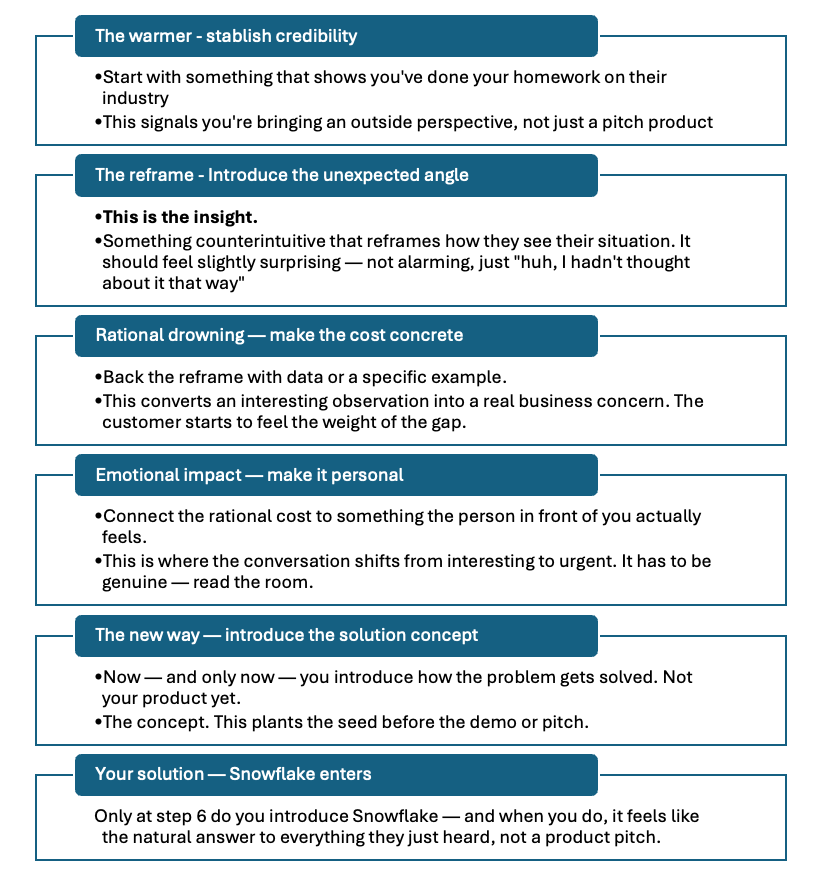
| T Teach Lead with insight the customer didn’t have Reframe -> Rational Drowning -> Emotional Impact -> New Way -> Your solution Most data teams think their bottleneck is compute speed — so they throw more hardware at it. But the companies growing fastest on data aren’t winning on raw performance. They’re winning because they can share clean, governed data with partners in real time — and their competitors can’t. Your Redshift setup might be fast enough for internal BI, but it wasn’t built for that external data-sharing model. That’s the gap most data leaders don’t see until a competitor has already built it. | T Tailor Adapt the insight to what each stakeholder cares about Depending on the role, stakeholders care about different things. You take one commercial insight and translate it into the specific outcome each persona cares about most. Keep the insight the same, framing it based on the stakeholder. Common mistake: Using the same pitch deck for every person in the room. Great SEs read the room and shift emphasis mid-conversation. Same insight (data sharing gap), three framings: To the CFO — “Your competitors are monetizing data as a product line. You’re leaving revenue on the table.” To the CTO — “Your team is rebuilding custom integrations every time a partner needs data access. That’s engineering cost you don’t have to pay.” To the Head of Analytics — “Your analysts are waiting on engineers for data they should be able to access themselves. That’s the bottleneck this solves. | T Take control Drive the sale with confidence, no aggression When a customer pushes back on price, timeline, or feasibility, challengers don’t cave — they redirect. Taking control doesn’t mean being pushy. It means being willing to hold your position, reframe objections, and keep the deal moving when the customer’s instinct is to stall. When the customer says: We will think about it. The challenger replies: I understand, what specifically you need to think through? I’d rather to help you work through instead of having you spend the weekend in something I can answer in 5 minutes. Common mistake: Confusing assertiveness with aggression. Taking control is about redirecting and reframing — not bulldozing. The tone is confident and curious, not combative. Customer: “Snowflake’s pricing model makes us nervous — it’s consumption-based and we can’t predict costs.” Challenger response: “That concern comes up a lot, and it’s valid. Here’s what I’d push back on though — your current Redshift bill is fixed whether you use it or not. With Snowflake, you pay for what you use, and you can set budget alerts and warehouse limits so spend never surprises you. The question is: do you want to pay for capacity you might not use, or for compute you definitely did?” |
Insight Pitch Structure
Different people care about different things
| Role | Cares about |
| CFO Chief Financial Officer | Cost predictabilityROIRisk ReductionCompetitive position |
| CTO Chief Technology Officer | Platform longevityEngineering leverageSecurityTechnical Debt |
| VP of Data Engineering | Team productivity ReliabilityReducing toilLooking good to leadership |
| Director of Analytics | Query speedSelf-service accessData QualityAnalyst Productivity |
When asking about which tool is better: The real question isn’t which platform does more — it’s which one your whole organization can actually use and trust.
How do SPIN Selling and the Challenger Sale work together? When do you use each?
- Challenger leads the conversation; SPIN depends on it.
- Challenger is the opening posture, and SPIN as your discovery engine once you’re inside the organization
- You open as a Challenger; you lead with a commercial insight that reframes their thinking. This earns credibility and gets them leaning forward.
- Then you switch into SPIN mode, you ask Situation and Problem questions to understand their specific context, Implication questions to deepen the pain, and Need-payoff questions to let them articulate the value of solving it.
In an interview: If asked “what sales methodologies do you know?”, say you use
That answer shows you understand that frameworks aren’t competing — they’re complementary tools for different moments in the sale. That level of sophistication will stand out from most candidates.
Challenger to open and position, SPIN to run discovery, and MEDDPICC to qualify and track deal health.
 Daniela Fernandez